Monday, February 10, 2025

The world's best city for business where most billionaires live

This city is widely seen as the most business friendly city on Earth where many millionaire and billionaire reside

Ever wondered where the world’s millionaires and billionaires are calling home?

Look no further than Singapore, the city-state that continues to attract the wealthy from across the world.

Singapore has overtaken London ranking as fourth wealthiest city in the world, according to the 2024 World’s Wealthiest Cities Report by Henley & Partners. 

Singapore is reportedly home to 244,800 millionaires, 336 centi-millionaires and 30 billionaires, according to the report. 

This means that nearly 4.31% of Singapore's population is made up of millionaires, with a staggering 64% growth in their numbers between 2013 and 2023.

Singapore,[f] officially the Republic of Singapore, is an island country and city-state in Southeast Asia. The country's territory comprises one main island63 satellite islands and islets, and one outlying islet. It is about one degree of latitude (137 kilometres or 85 miles) north of the equator, off the southern tip of the Malay Peninsula, bordering the Strait of Malacca to the west, the Singapore Strait to the south along with the Riau Islands in Indonesia, the South China Sea to the east, and the Straits of Johor along with the State of Johor in Malaysia to the north.

Republic of Singapore
Malay:Republik Singapura
Mandarin:新加坡共和国
Xīnjiāpō Gònghéguó
Tamil:சிங்கப்பூர் குடியரசு
Ciṅkappūr Kuṭiyaracu
Motto: Majulah Singapura (Malay)
"Onward Singapore"
Anthem: Majulah Singapura (Malay)
"Onward Singapore"
Duration: 1 minute and 20 seconds.
Singapore has become an important financial hub

It is estimated that 3,400 high-net-worth-individuals moved there in 2023 alone. 

According to Forbes, the three richest billionaires residing in Singapore are Eduardo Luiz Saverin, co-founder of Facebook; brothers Robert and Philip Ng, who control Far East Organization, one of Singapore's largest private landlords and property developers; and Li Xiting, co-founder and chairman of Shenzhen Mindray Bio-Medical Electronics, a prominent supplier of medical devices.

The city’s favourable tax policies, strategic location in Asia, and growing economy make it an apparent magnet for business moguls, investors, and entrepreneurs seeking to grow their fortunes.

Singapore's history traces back to its origins as a fishing village and outpost for the Srīvijayan Empire.

By salisu umar manta
salisuumarmanta@gmail.com

The Most expensive cow in the world

 Viatina-19

Viatina-19, a Nelore cow from Brazil, was sold for a record $4 million, making her the world's most expensive cow. Renowned for her unmatched genetics and muscular build, Viatina-19's lineage will influence future cattle breeding.

Viatina-19, a Nelore cow from Brazil, was sold for a record $4 million, making her the world's most expensive cow. Renowned for her unmatched genetics and muscular build, Viatina-19's lineage will influence future cattle breeding. The Nelore breed, originally from India, is highly valued for its heat tolerance, disease resistance, and reproductive capacity

Cows play a crucial role in agriculture and some specific breeds have extraordinarily sky high prices due to their uncommon genetics, superior quality genes, and unique traits.
These elite bovines are precious and expensive possessions that get millions of dollars at auctions. Among the most expensive cows are the Wagyu from Japan and the Brahman cows from India, which are highly resilient and adaptable to hot climates. Recently, a Nelore cow named Viatina-19 from Brazil set a new record by being sold for a staggering $4 million.

Viatina-19 has made history in Minas Gerais, Brazil, as the world’s most expensive Nelore cow. At 1,101 kg that is double the weight of a typical adult of her breed.

She’s the world’s most expensive cow, and part of Brazil’s plan to put beef on everyone’s plate


UBERABA, Brazil (AP) — Brazil has hundreds of millions of cows, but one in particular is extraordinary. Her massive, snow-white body is watched over by security cameras, a veterinarian and an armed guard.

Worth $4 million, Viatina-19 FIV Mara Movéis is the most expensive cow ever sold at auction, according to Guinness World Records. That’s three times more than the last recordholder’s price. And — at 1,100 kilograms (more than 2,400 pounds) — she’s twice as heavy as an average adult of her breed.

Along a highway through Brazil’s heartland, Viatina-19’s owners have put up two billboards praising her grandeur and beckoning ranchers, curious locals and busloads of veterinary students to make pilgrimages to see the supercow.

Climate scientists agree that people need to consume less beef, the largest agricultural source of greenhouse gasses and a driver of Amazon deforestation. But the cattle industry is a major source of Brazilian economic development and the government is striving to conquer new export markets. The world’s top beef exporter wants everyone, everywhere to eat its beef.

The embodiment of Brazil’s cattle ambitions is Viatina-19, the product of years of efforts to raise meatier cows. The country’s prizewinners are sold at high-stakes auctions — so high that wealthy ranchers share ownership. They extract the eggs and semen from champion animals, create embryos and implant them in surrogate cows that they hope will produce the next magnificent specimens.


We’re not slaughtering elite cattle. We’re breeding them. And at the end of the line, going to feed the whole world,” one of her owners, Ney Pereira, said after arriving by helicopter at his farm in Minas Gerais state. “I think Viatina will provide that.”

The cow’s eye-popping price stems from how quickly she put on vast amounts of muscle, from her fertility and — crucially — how often she has passed those characteristics to her offspring, said Lorrany Martins, a veterinarian who is Pereira’s daughter and right hand. Breeders also value posture, hoof solidity, docility, maternal ability and beauty. Those eager to level up their livestock’s genetics pay around $250,000 for an opportunity to collect Viatina-19’s egg cells.

She is the closest to perfection that has been attained so far,” Martins said. “She’s a complete cow, has all the characteristics that all the proprietors are looking for.”


Ney Pereira and his daughter, veterinarian Lorrany Martins, give an interview inside a stable at his farm in Uberaba, Minas Gerais state, Brazil, Friday, April 26, 2024. (AP Photo/Silvia Izquierdo)

By salisu umar manta

salisuumarmanta@gmail.com 

Geologists Uncover One of the Largest Gold Reserve Ever, Worth 78 Billion Euros

 A hidden deposit, long buried beneath the earth, has just been uncovered, revealing an astonishing amount of gold. Experts are still piecing together the full scale of this discovery, but early estimates suggest its value is beyond expectation. The implications for the industry are only beginning to take shape, with further exploration hinting at even greater potential.

A significant gold deposit, valued at approximately 78 billion euros (600 billion yuan), has been discovered in Pingjiang County, located in Hunan provinceChina. With an estimated 1,000 tons of gold, this find has the potential to reshape both China’s gold industry and the global mining sector. The discovery, made within the Wangu gold field, is expected to drive economic growth and attract significant attention from mining companies worldwide.

A Deep Underground Wealth Revealed

The Geological Bureau of Hunan Province has identified over 40 gold veins within the Wangu gold field, located at depths of approximately 2,000 meters beneath the surface. The veins are estimated to contain around 300 metric tons of gold at this depth. However, further drilling reaching 3,000 meters has revealed additional promising reserves, with projections suggesting that total reserves could exceed 1,000 metric tons. This makes the deposit one of the largest gold discoveries in recent history.

Geologist Chen Rulin emphasized the exceptional nature of this discovery, stating that many of the rock cores drilled exhibited visible gold, an unusual occurrence in geological exploration. Some samples contained up to 138 grams of gold per metric ton of ore, highlighting the extraordinary richness of this deposit. Such high-grade mineralization significantly enhances the economic feasibility of extraction.

the Way

This discovery was made possible through the use of cutting-edge geological exploration techniques, particularly three-dimensional geological modeling. These advanced methods allowed geologists to map underground gold veins with remarkable precision.

According to Liu Yongjun, deputy director of the Hunan Geological Bureau, these technologies played a crucial role in identifying the richest zones of the deposit. Exploration efforts have also revealed promising signs beyond the core gold veins, suggesting that the deposit could be larger than initially anticipated.

The methods used in this discovery reflect a broader trend in the mining industry, where advanced geophysical surveys, computerized modeling, and deep-core drilling enable the detection of previously inaccessible resources. The integration of these modern technologies marks a new era for mineral exploration

Economic Impact and Industry Implications

With a gold reserve of this magnitude, Hunan province could emerge as a major player in the global gold market. The economic benefits of the discovery extend beyond mining operations, with potential impacts on:

  • Job creation: Thousands of new positions in mining, refining, transportation, and associated industries.
  • Infrastructure development: Improved roads, rail networks, and energy supply to support large-scale extraction.
  • Foreign and domestic investment: Increased interest from international mining corporations and financial institutions.

The Wangu gold field is now considered one of the largest gold deposits globally, surpassing notable reserves such as South Africa’s South Deep mine, which holds approximately 900 metric tons of gold. The discovery places China among the top global gold producers, reinforcing its influence in the global precious metals market.

However, large-scale extraction presents challenges, particularly in environmental sustainability. Experts stress the need for rigorous feasibility studies to ensure responsible mining practices. Authorities must address concerns such as land degradation, water resource management, and carbon emissions while balancing economic growth.

Hunan’s New Role in Global Gold Production

This discovery establishes Hunan province as a key region for China’s gold production industry. The vast reserves found in the Wangu gold field could elevate the region’s status as a strategic mining hub, attracting both domestic and international investment.

As exploration continues, the potential for uncovering additional resources remains high. The discovery underscores the growing importance of modern geological technology, which enables mining companies to detect and extract resources from extreme depths.

The significance of this massive gold deposit extends beyond China—it represents a landmark moment for the global mining industry. As technological capabilities advance, the potential for deep-resource exploration could transform the future of mineral extraction, revealing hidden reserves once considered inaccessible.

By salisu umar manta

salisuumarmanta@gmail.com


Wednesday, February 5, 2025

Four Israeli hostages reunited with families as 200 Palestinian prisoners released

 Exclusive: First reaction from Israeli hostage’s family as their loved on is released by Hamas

CNN News

What we covered here

• Four female Israeli soldiers have been freed and reunited with their families in the latest round of releases under the Israel-Hamas ceasefire agreement. The women were abducted when Hamas overran their base on October 7, 2023.

• Hamas put on show of force during their handover at Gaza City’s Palestine Square, waving green flags and displaying a poster of current and former Israeli leaders alongside the word “failure.” It appeared to be a message to Israel the group remains a force despite the 15-month Gaza war.

• Israel says that Gazans will not be able to return north amid a dispute over the release of a civilian Israel had expected to be freed Saturday. The Palestinian Islamic Jihad movement says it is holding 29-year-old Arbel Yehud, with a source saying she is still alive.

• Israel’s prison service confirmed that 200 Palestinian prisoners - including some serving life sentences - were released from detention facilities as part of the ceasefire and hostage release deal.


Four Israeli hostages released by Hamas in carefully-staged handover


BBC news

Four female Israeli soldiers taken hostage by Hamas on 7 October 2023 have been released as part of a ceasefire agreement which also saw 200 Palestinian prisoners freed.

Karina Ariev, Daniella Gilboa, Naama Levy and Liri Albag, all aged between 19 and 20, were released to the Red Cross in Gaza City during a heavily-choreographed handover involving dozens of Hamas gunmen.

However, Israel accused Hamas of breaching the terms of the ceasefire because female civilian hostage Arbel Yehud was not included in Saturday's release and has delayed the planned return of displaced Palestinians to northern Gaza.

Hamas says the hostage will be released next weekend. It has not provided any details.

Despite the dispute, Israel released the Palestinian prisoners - among them 70 people who were immediately deported to neighbouring countries via Egypt due to the seriousness of their offences.

Some of the prisoners will be transferred to Gaza, while others will be allowed to return to their homes in the occupied West Bank and East Jerusalem.

The swap on Saturday was the second exchange since a ceasefire came into effect on 19 January. Three hostages and 90 Palestinian prisoners were released in the first swap a week ago.

Four Israeli hostages released by Hamas in carefully-staged handover

Nick Beake and Barbara Tasch
in Jerusalem and London
Reuters Images of the four Israeli soldiers meeting their familiesReuters
The four soldiers met their families moments after returning to Israel

Four female Israeli soldiers taken hostage by Hamas on 7 October 2023 have been released as part of a ceasefire agreement which also saw 200 Palestinian prisoners freed.

Karina Ariev, Daniella Gilboa, Naama Levy and Liri Albag, all aged between 19 and 20, were released to the Red Cross in Gaza City during a heavily-choreographed handover involving dozens of Hamas gunmen.

However, Israel accused Hamas of breaching the terms of the ceasefire because female civilian hostage Arbel Yehud was not included in Saturday's release and has delayed the planned return of displaced Palestinians to northern Gaza.

Hamas says the hostage will be released next weekend. It has not provided any details.

Despite the dispute, Israel released the Palestinian prisoners - among them 70 people who were immediately deported to neighbouring countries via Egypt due to the seriousness of their offences.

Some of the prisoners will be transferred to Gaza, while others will be allowed to return to their homes in the occupied West Bank and East Jerusalem.

The swap on Saturday was the second exchange since a ceasefire came into effect on 19 January. Three hostages and 90 Palestinian prisoners were released in the first swap a week ago.

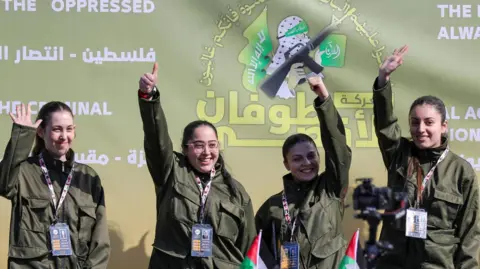
Reuters Four female Israeli soldiers, who were held in Gaza, wave from a stage as they are released by Hamas Reuters
The soldiers waved from the stage in Gaza City

Saturday's event in Palestine Square, Gaza City, was highly choreographed by Hamas, unlike last weekend's chaotic handover.

The four hostages emerged from cars and were shepherded by masked gunmen to a stage erected in the square, where moments earlier a Red Cross official had sat at a desk to sign documents with a Hamas fighter.

The hostages and the masked gunmen wore lanyards around their necks containing laminated ID badges, each with their own sort of accreditation for the event.

The stage was set up with a desk and flags, symbols of bureaucracy - but alongside the platform was a machine gun.

The four Israeli women were seen waving, smiling and holding hands as crowds of Hamas gunmen and Palestinian civilians looked on.

Hamas – which gave each hostage a bag of items to take with them back to Israel – will hope these carefully crafted images project order as well as strength.

The intended recipients of the message was likely aimed at both Palestinians hoping to run Gaza one day, and at Israeli Prime Minister Benjamin Netanyahu, who had vowed to destroy the group in the aftermath of the 7 October attacks.

For Israelis, there was huge relief that another four hostages - who were reunited with their families shortly after being freed - are safe.

Their families released statements celebrating the women's freedom, with Daniella Gilboa's family saying she had "survived 477 days in hell in Gaza and now she has returned to a family embrace with us".

Last week, many felt fury that the first three women released were unceremoniously bundled away during the handover.

After Saturday's wildly contrasting scenes, another kind of anger was likely: at the public parading of the women in their final moments before being given their freedom.


Celebrations in the West Bank

Meanwhile in the West Bank, 200 Palestinian prisoners were released to jubilant scenes.

Some of the released prisoners were hoisted aloft by crowds to loud cheers and fireworks after they stepped off buses.

A total of 121 of the 200 released had been serving life sentences in Israeli jails - some were convicted of multiple murders, including the killing of Israeli civilians.

Some of the prisoners had been held for short periods of time, and some were never charged with a crime but were held under something called administrative detention.

The youngest Palestinian prisoner released on Saturday was 16 years old and the oldest was 69.

"Thank God! It's a great feeling, I can't describe this feeling! I've been in jail six years and two months," released prisoner Bakker Kwaawish said.

By salisu umar manta

salisuumarmanta@gmail.com